
Pokkali Farming Best Practices

Adherance to centuries old time tested traditional Pokkali Farming practice delivers successful and profitable Pokkali cultivation from sowing to harvesting.
Field Preparation: Rice cultivation is done during low salinity, while aquaculture is carried out during high salinity. By mid-April the soil mounds are dried and after April 14, sluices (water gates) are installed in the field to regulate water flow during tidal changes. Water channels and dikes are made followed by ploughing. The field is suitable for sowing once the monsoon has removed salt from the soil. [Kerala Karshakan e-Journal November 2022]
Seed Preparation: For sowing, sprouted seeds are used. Baskets made of Teak, arrow roots, or coconut, leaves that can hold 10 kg seeds are used to submerge seeds in water for 12 to 18 hours without sun exposure. Within 6-8 days the seed germinates. When the weather is favorable, sowing is done. Before sowing; the seed baskets are again soaked in water for 6 hours. If the monsoon gets delayed, sowing is postponed. But two times water dipped seeds should be sown within 2-3 days. [Kerala Karshakan e-Journal November 2022]
Farming Practices: On the fifth day after sowing, shoots of saplings are visible, which is known as Panchakanam in Malayalam. Later on, on the 28 th day weeds are removed from the paddy before transplantation, in Malayalam, this process is termed as Valaymatheerna divasam by the ancestors. After 100 days, rice spikes will be visible and in the next 20 days, the grain ripens to a golden color and is ready for harvest. Harvesting is done in the Malayalam month of Thulam. [Kerala Karshakan e-Journal November 2022]
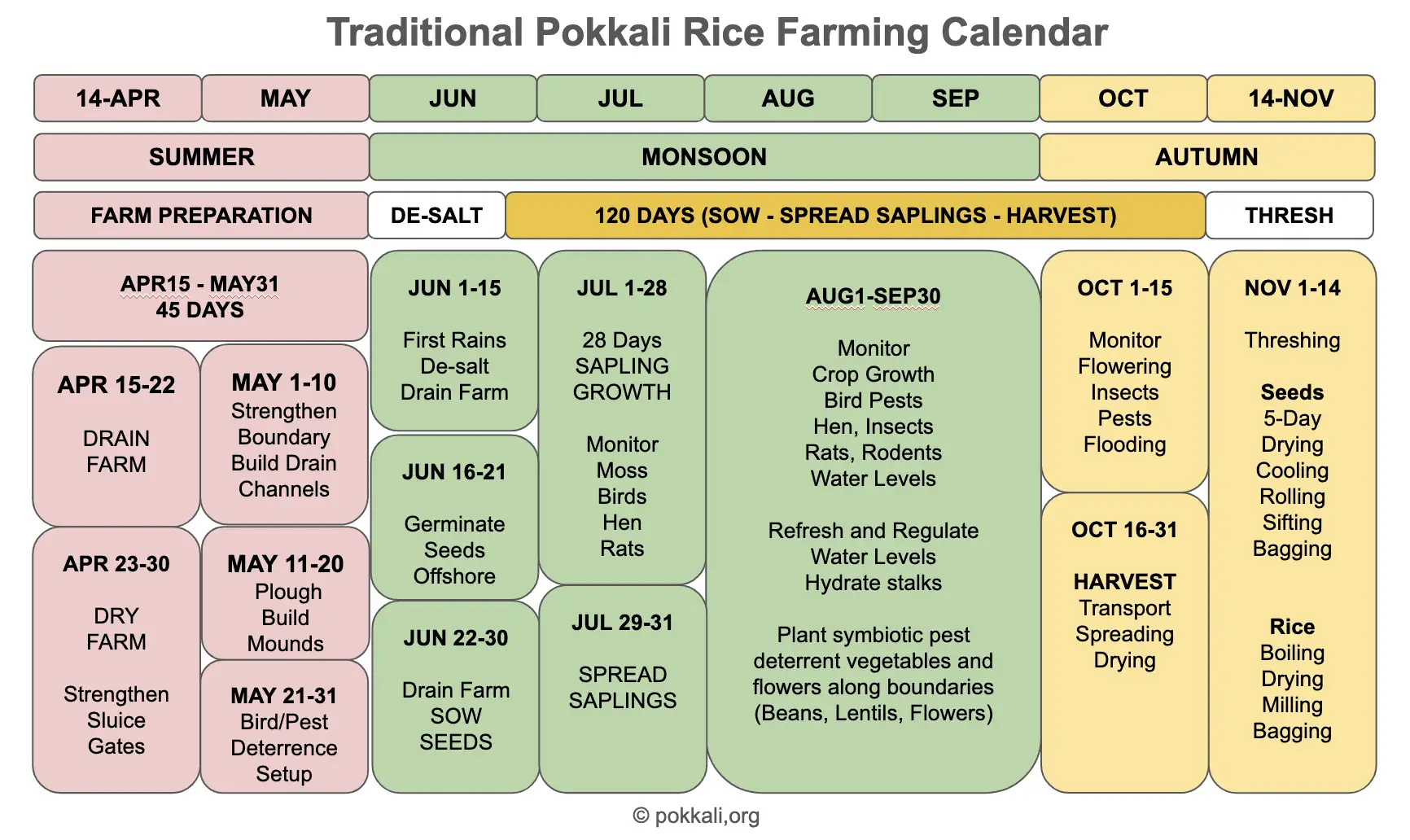
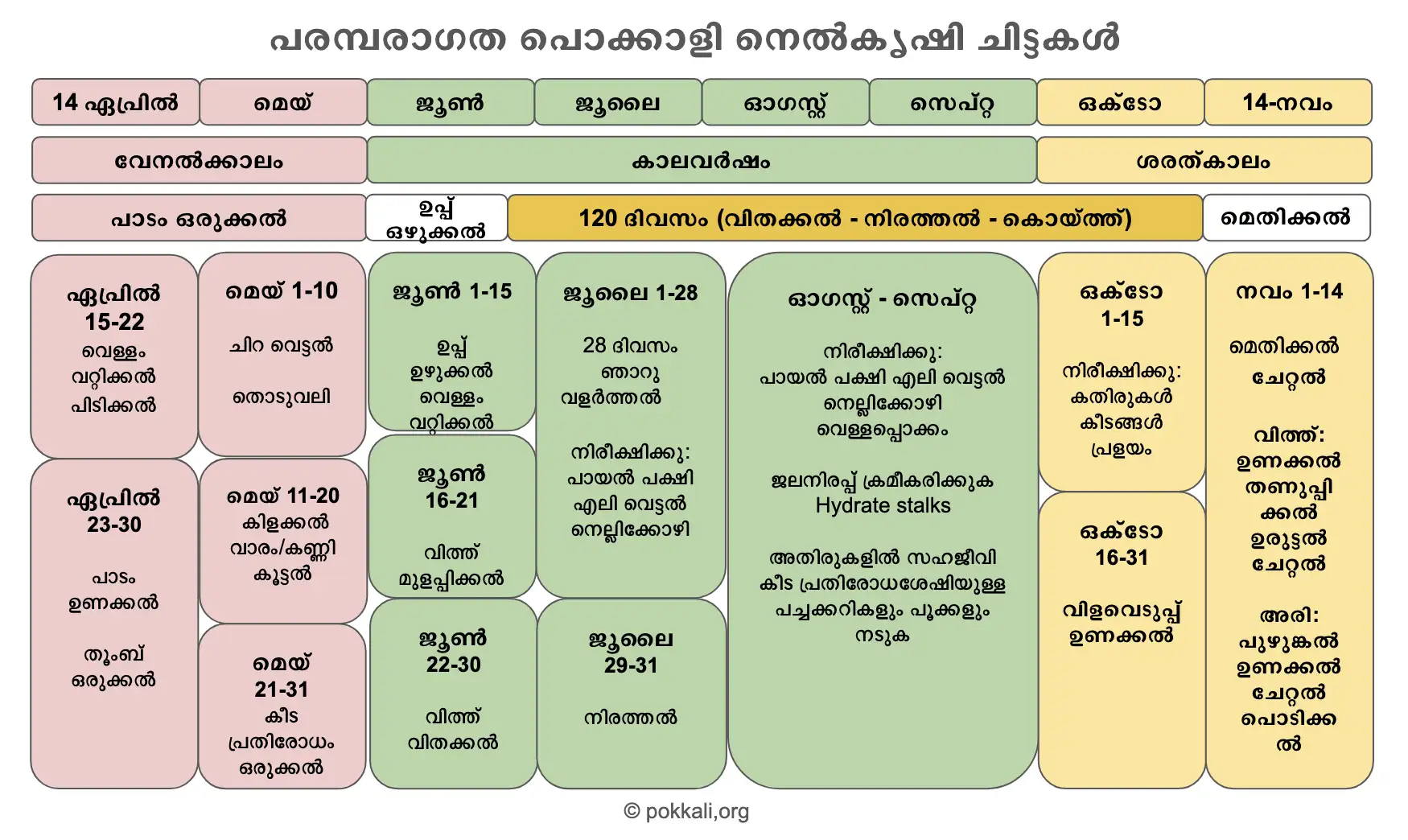
Best Practice: Farm Preparation (April/May)
General: "By April, the bunds are being strengthened and sluices repaired for regulating water level. Fields are then drained during low tide and the sluices are closed. When the soil in the field becomes dry, mounds of 1 m base and 0.5 m height are formed. This facilitates the washing down of the dissolved salts from the surface of the mounds with the onset of monsoon, which are ultimately removed from the field by tidal action. The mounds act as elevated in situ nursery and protect the seedlings from flash floods. Source: Package Of Practice, Kerala Agricultural University"
Drain and dry the farm (April)
Drain and dry the farm starting April 15th as per traditional practice and guidance from Kerala Agriculture University and the PLDA (Pokkali Land Development Authority) directives issued by District Collector. Open sluice gate aligned with low tide. Close gate once the farm is dranined. Let the farm dry out over the next week in the sun.
Ploughing and Mounds Preparation (May)
Plough and turn over dry soil. Use hand tiller or light machine since the clay farms hardens in the summer months for its use.
Create square clay mounds of atleast 0.5 meter height and 1 meter sides. Leave gaps between mounds. Line up mounds in rows across the farm. a 1-2feet n height for sowing germinated seeds and water channels for water draining?
Boundary Wild Foliage Clearing (May)
Clear all wild foliage growth, bird nests and rodent tunnels along farm boundaries (cheras) of farm in the summer months.
Boundary Strengthening (May)
Reinforce height and strength of farm boundaries (cheras)
Plug all leaking holes (Kallans) created by rodents in the farm boundaries (cheras)
Sluice Gate Strengthening (May)
Reinforce height, plug any leaks, prepare Sluice Gate wooden planks and strengthen the Sluice Gate attachments.
Bird and Pest Deterrance (May)
Setup bird deterrent strings with ribbons, scarecrows, bottles with rattling stones or other traditional forms of bird deterrents.
Setup nettings as bird deterrents
Plug all visible farm rat tunnels along boundary bunds/cheras
Soil Salt Draining (June)
Allow first weks of monsoon to drain soil salts from farm mounds with appropriate sluice gate control
Drain farms to ensure mounds were maintained and protected from water logging with appropriate sluice gate control
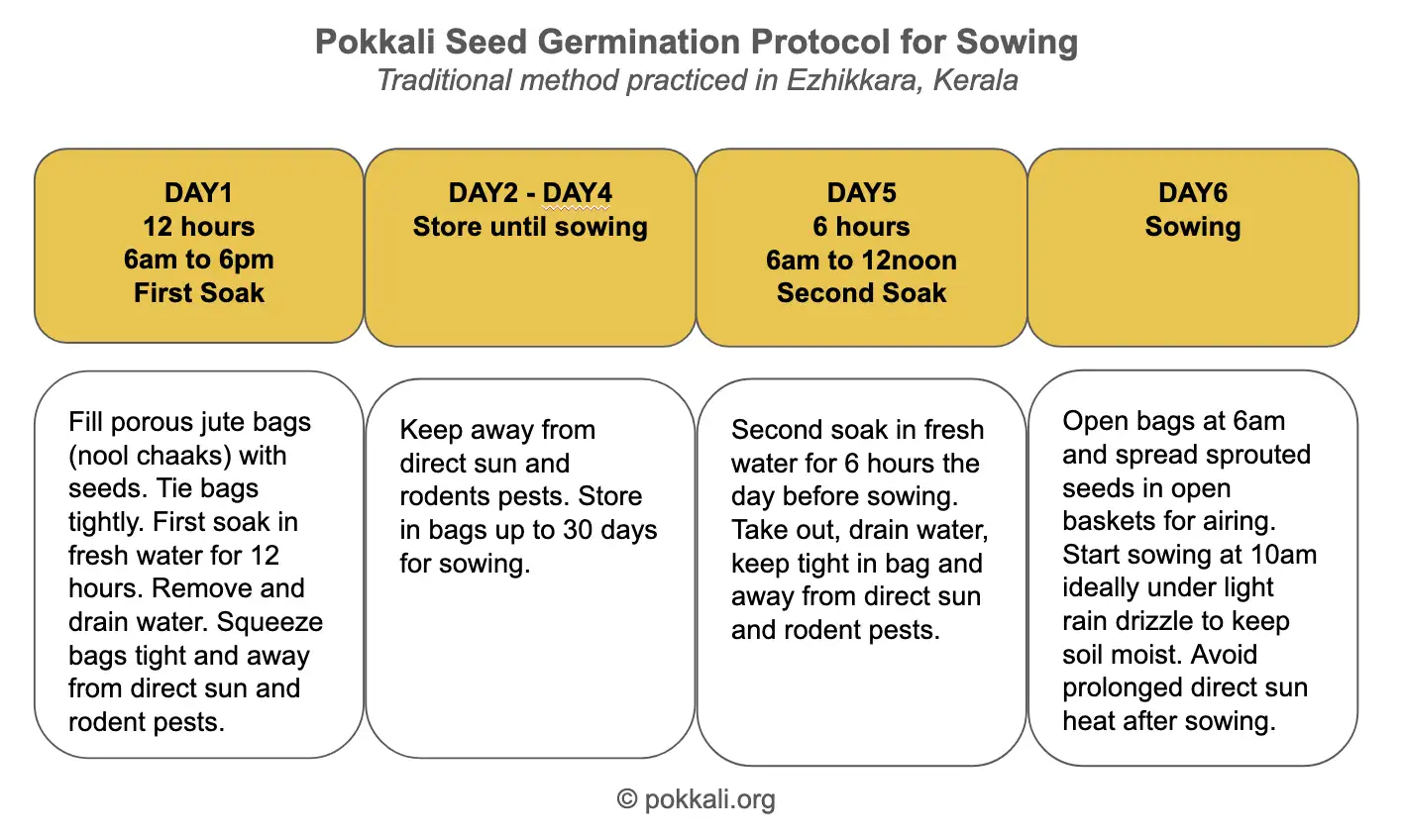
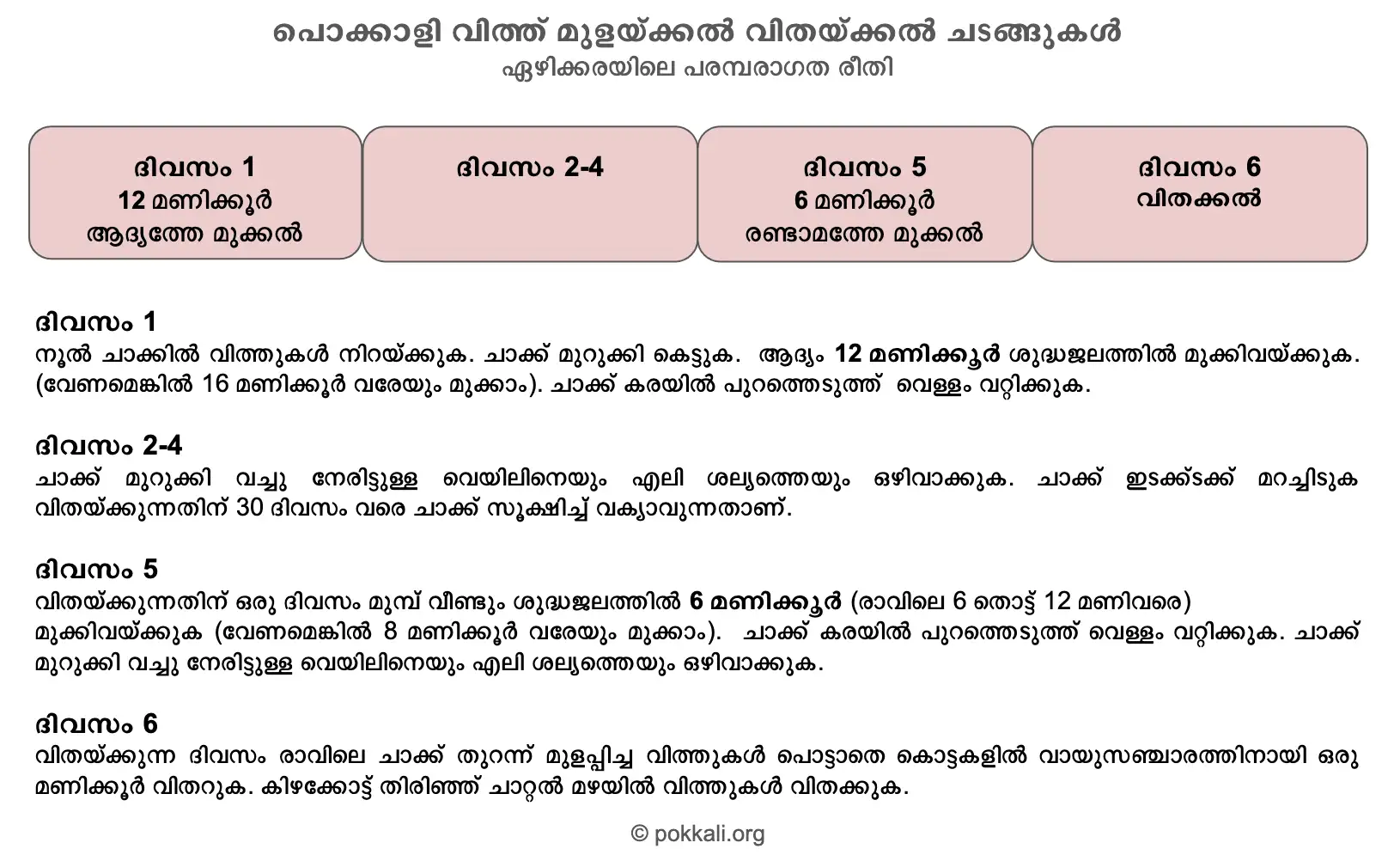
Seed Germination (June)
General: "A special method is adopted for sprouting the seeds. The seeds are tightly packed in baskets made of plaited coconut leaves, the inside of which is lined by banana or teak leaves. These baskets are then immersed in fresh water ponds for 12 to 15 hours. They are then taken out and stored in shade. The radicle just sprouts and remains quiescent under this condition for more than 30 days. When the soil and weather conditions
become favourable for sowing, the baskets containing the seeds are re-soaked for 3 to 6 hours before sowing. The mounds in the field are then raked and top levelled. The sprouted seeds are sown on the top of mounds, which act as an in situ nursery. When the seedlings reach a height of 40-45 cm (in 30-35 days), the mounds are cut into pieces with a few seedlings, which are uniformly spread in the field. Source: Package Of Practice, Kerala Agricultural University"
Adhere to traditional and required 1-week timed soak-dry-soak seed germination sequenced process. Use porous gunny bags or traditional soak bags made from coconut leaves with inner linings of teak or banana leaves.
Align seed germination process timed with the intended date of sowing in mid to late June.
Seed Sowing (June)
Sow seeds (hand scatter) on top of prepared mounds aligned with weather sometime bewtween June 1th and June 30th. Wait out heavy rain days to avoid seeds getting washed away.
Monitor farm in the critical first week of sowing to protect seeds from moss/algae cover, birds, rodents and water logging.
Mnitor farm for atleast 28 days after sowing until sapling growth to atleast 2-feet in height is realized.
Sapling Spreading (July)
Hand pluck the 2-feet high saplings with root clay clump from moist mounds and spread (hand drop) them evenly across the farm. The clay clump will initially droop down when dropped but will become naturally upright (a beautiful sight to behold) once the root clumps take hold in the farm with rain water accumulation.
Farm Monitoring (August-September-October)
Monitor the farm in the months of August and September
Ensure periodic water inflow/outflow from the farm using Sluice Gates
Monitor farm water level with Sluice Gates to prevent stalks from getting fully submerged
Monitor farm during the flowering stage for insect (Chaazhi etc) pests (if any) in late September or early October
Harvesting (October)
Monitor farm during the golden grain stage of the crop for bird pests (if any) in October
Start harvesting the crop when atleast 80% of the farm has golden grains
Accumulate harvested stalk sheaves along cheras for draining of water
Transport harvested stalk sheaves to prepared Kalams (flat surface areas) for drying and threshing immediately after harvesting. Time harvesting to align with sunny days. Harvest early in the morning and let the day sun dry the sheaves.
Deploy traditional 3-5days of natural sun drying, stalk rolling, and mist cooling sequences to isolate high quality germinatable seeds for next years cultivation. Split open the red grain and check if you are able to see atleast 25% of diametricallu centered white kernel.
Threshing and Sifting (November)
Use a mechanical threshing machine or the traditional manual foot threshing to dislodge grains from stalks.
Spread out grain in a flat surface in the sun for it to dry. Create criss-cross rows of grains and have it turned over every few hours for even drying of grains.
Storage (November)
Store germinatable seeds seperately in dark/cool/dry place for next year's sowing
Store seeds in a dark/cool/dry room in a traditional wood pathhayam (box)
Store seeds in breathable narutal fiber gunny bags
Selling
Ensure seeds and rice are sold at the premium market rates for high quality traditional heirloom (not hybrid Vyttila-x) Pokkali rice. Use online channels to reach customers.
Field Preparation: Rice cultivation is done during low salinity, while aquaculture is carried out during high salinity. By mid-April the soil mounds are dried and after April 14, sluices (water gates) are installed in the field to regulate water flow during tidal changes. Water channels and dikes are made followed by ploughing. The field is suitable for sowing once the monsoon has removed salt from the soil. [Kerala Karshakan e-Journal November 2022]
Seed Preparation: For sowing, sprouted seeds are used. Baskets made of Teak, arrow roots, or coconut, leaves that can hold 10 kg seeds are used to submerge seeds in water for 12 to 18 hours without sun exposure. Within 6-8 days the seed germinates. When the weather is favorable, sowing is done. Before sowing; the seed baskets are again soaked in water for 6 hours. If the monsoon gets delayed, sowing is postponed. But two times water dipped seeds should be sown within 2-3 days. [Kerala Karshakan e-Journal November 2022]
Farming Practices: On the fifth day after sowing, shoots of saplings are visible, which is known as Panchakanam in Malayalam. Later on, on the 28 th day weeds are removed from the paddy before transplantation, in Malayalam, this process is termed as Valaymatheerna divasam by the ancestors. After 100 days, rice spikes will be visible and in the next 20 days, the grain ripens to a golden color and is ready for harvest. Harvesting is done in the Malayalam month of Thulam. [Kerala Karshakan e-Journal November 2022]